
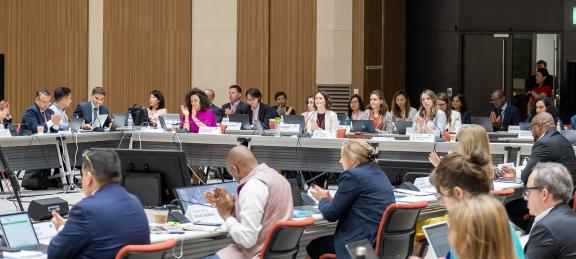
The Green Climate Fund (GCF) has approved $1 billion in funding for 17 new climate projects in developing countries, bringing its total portfolio to 270 projects valued at nearly $15 billion across 130 countries.
The landmark decision at the 39th Board Meeting clears the way for 17 new climate projects in developing countries, increasing GCF’s portfolio to 270 projects valued at nearly $15 billion across 130 countries. The approved initiatives include GCF’s first country project in Albania, its first-ever project focused on social protection in Mozambique, and its first project led by a local country partner in Bhutan.
National entities in Tajikistan, Nigeria, and Côte d’Ivoire will now be able to access GCF resources for the first time. The 39th Board meeting of the Green Climate Fund concluded with a landmark approval of $1.0 billion in GCF financing for 17 projects in 35 developing countries. The decision expands GCF’s portfolio to 270 projects to an expected total of $58.7 billion, including $14.9 billion in committed GCF funding.
Among the 17 projects, three projects involve first-time Accredited Entities (AEs), including a Direct Access Entity (DAE) in Bhutan set to implement a climate resilience project in the country. Eastern Europe and Central Asia received a boost with the first GCF-backed single-country project in Albania and the accreditation of a new partner from Tajikistan.
The approved projects are:
– SAP038: Climate Adaptation, Resilience and Engagement in Local Governments (CARE-LG) in Bhutan
– SAP039: Integrated Climate Risk Management in Pakistan: Integrated climate risk management for strengthened resilience to climate change in Buner and Shangla Districts of Khyber Pakhtunkhwa Province with World Food Programme (WFP)
– SAP040: Climate Adaptation and Resilience in Vietnam (CARe Hue)
– SAP041: ALBAdapt – Climate Services for a Resilient Albania
– SAP042: Building Climate Resilience by Linking Climate Adaptation and Social Protection in Mozambique (LINK)
– SAP043: Upscaling “Naatangué” Integrated Family and Village Farms in Senegal
– FP232: Jordan Integrated Landscape Management Initiative (JILMI)
– FP233: Community-based Agriculture Support Programme ‘plus’ (CASP+) in Nepal
– FP234: Tonga Coastal Resilience
– FP235: Mangroves for Climate in Ecuador
– FP236: Basin Approach for Livelihood Sustainability through Adaptation Strategies (BALSAS) in Nepal
– FP237: E-Motion: E-Mobility and Low Carbon Transportation in Chile
– FP238: Ecosystems-based Adaptation for Resilient Watersheds and Communities in Malawi (EbAM)
– FP239: Building Climate Resilience for Food and Livelihoods in the Horn of Africa (BREFOL)
– FP240: Collaborative R&DB Programme for Promoting the Innovation of Climate Technopreneurship in Korea
– FP241: Financing Mitigation and Adaptation Projects (FMAP) in Indian MSMEs
– FP242: Caribbean Net-Zero and Resilient Private Sector
The GCF signed Funded Activity Agreements for 10 projects immediately after approval. Projects in Bhutan and Malawi are expected to transition from approval to first disbursement in under 15 days, a new record for GCF.
The Fund sharpened its focus on climate adaptation, particularly in vulnerable regions, including initiatives in Least Developed Countries (LDCs), Small Island Developing States (SIDS), and African nations. GCF approved its first-ever social protection project in Mozambique and a project enhancing resilience to extreme weather and food insecurity in the Horn of Africa.
The Board also approved the accreditation of six new organisations, including three first-time Direct Access Entities (DAE) from Tajikistan, Nigeria, and Côte d’Ivoire, as well as the first regional DAE representing Indian Ocean SIDS. This brings the total number of GCF Accredited Entities to 134.
The accreditation agreement with the DAE from Tajikistan was signed immediately after approval, marking a record time for such an agreement. In addition, the Board considered key policies and strategies, including a new partnerships and access strategy that will set the stage for further discussions on enhancing access and streamlining accreditation.
GCF Executive Director Mafalda Duarte said: “The approval of $1 billion for 17 projects in a single Board meeting is a significant milestone that demonstrates our commitment to supporting the highest aspirations of developing countries.”
The 40th meeting of the GCF Board will be held on October 21-24, 2024, in Songdo, Incheon, Republic of Korea.