
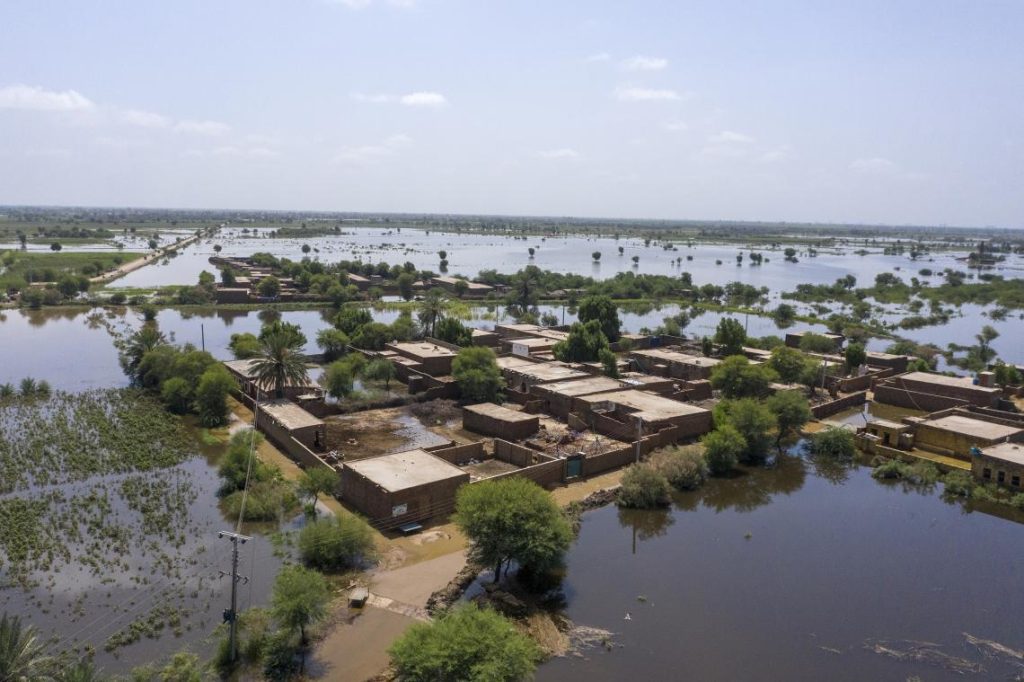
Federal Minister for Planning, Development, and Special Initiatives, Ahsan Iqbal, revealed that the 2022 floods in Pakistan caused a total of $30 billion in damages. The estimated recovery needs stand at $16.2 billion, with $10.9 billion in pledges received so far, leaving a funding gap of $17.1 billion.
Iqbal shared these details during the 4th meeting of the Policy and Strategy Committee (PSC) and the Oversight Board, which focused on post-flood reconstruction efforts.
Attendees included the Secretaries of Planning and Economic Affairs, chief secretaries from all provinces, as well as country directors from the World Bank and Asian Development Bank (ADB), the UN resident coordinator, the UNDP resident representative, the EU deputy head of mission, and senior officials from the Planning Commission.
The minister reported that the Post-Disaster Needs Assessment (PDNA) revealed total damages exceeding $14.9 billion, with economic losses reaching $15.2 billion.
He emphasized that the assessment projected a significant increase in food insecurity, forecasting that the number of people affected would grow from seven million to 14.6 million.
Additionally, over two million housing units were impacted, with 780,000 completely destroyed and more than 1.2 million sustaining partial damage.
In his opening remarks, Minister Iqbal described the unprecedented disaster that struck Pakistan from June to August 2022, triggered by heavy rains, river floods, and urban flash floods.
He highlighted that one-third of the country was submerged, impacting 33 million people and displacing nearly eight million. More than half of the districts in Sindh, Balochistan, and Khyber Pakhtunkhwa were declared disaster-affected.
In response to the 2022 floods, the Ministry of Planning developed the Government of Pakistan’s strategic policy framework known as the Resilient, Rehabilitation, and Reconstruction Framework (4RF).
The 4RF focuses on four primary goals: enhancing governance and institutional capacity to restore lives and livelihoods, revitalizing economic opportunities, fostering social inclusion and participation, and rebuilding and improving basic services and infrastructure in a resilient and sustainable manner.
The planning minister underscored the critical role of collaboration between Pakistan and its development partners in the wake of the devastating 2022 floods. He noted that several initiatives were launched to address the disaster, with substantial commitments from international partners.
He stressed the need for prompt and effective execution of projects aimed at rebuilding affected communities and restoring livelihoods. He stated, “The purpose of this forum is to assess the progress of projects agreed upon by federal and provincial governments and our development partners, while establishing a robust monitoring and evaluation mechanism to ensure transparency and efficiency, thus fostering greater trust among our partners.”
Addressing the challenges, Minister Iqbal pointed out a shift in the approach of development partners regarding resilience and adaptation. “Initially, we were advised to focus on long-term adaptation and resilience. However, as the Geneva Conference neared, there was a recommendation to pivot to short-term projects due to the high costs of adaptation. Despite this, the 4RF document comprehensively incorporates adaptation and resilience components to prepare us for future challenges,” he explained.
The minister also emphasized the urgent need to address climate change impacts, highlighting significant weather changes and substantial losses in agricultural production, particularly in cotton crops this year.
While discussing the Integrated Flood Resilience and Adaptation Project (IFRAP), the minister voiced concerns about the slow pace of flood reconstruction efforts in Balochistan, stressing the urgent need for accelerated action in this underdeveloped region.
He explained that the $400 million IFRAP is designed to assist approximately 35,100 homeowners with housing reconstruction grants to rebuild their homes to meet resilience standards.
The project will also offer livelihood grants to smallholder farmers to support livestock, promote climate-smart agriculture, and boost other productive activities. Additionally, it aims to restore essential services by rehabilitating damaged community infrastructure, such as water supply systems, irrigation, roads, and other amenities.
Minister Iqbal directed all relevant ministries to identify and resolve the gaps and obstacles hindering flood-resilient projects, emphasizing a strict zero-tolerance policy for delays. He also instructed that any incomplete PC-I documents be returned within 15 days to avoid further delays.