
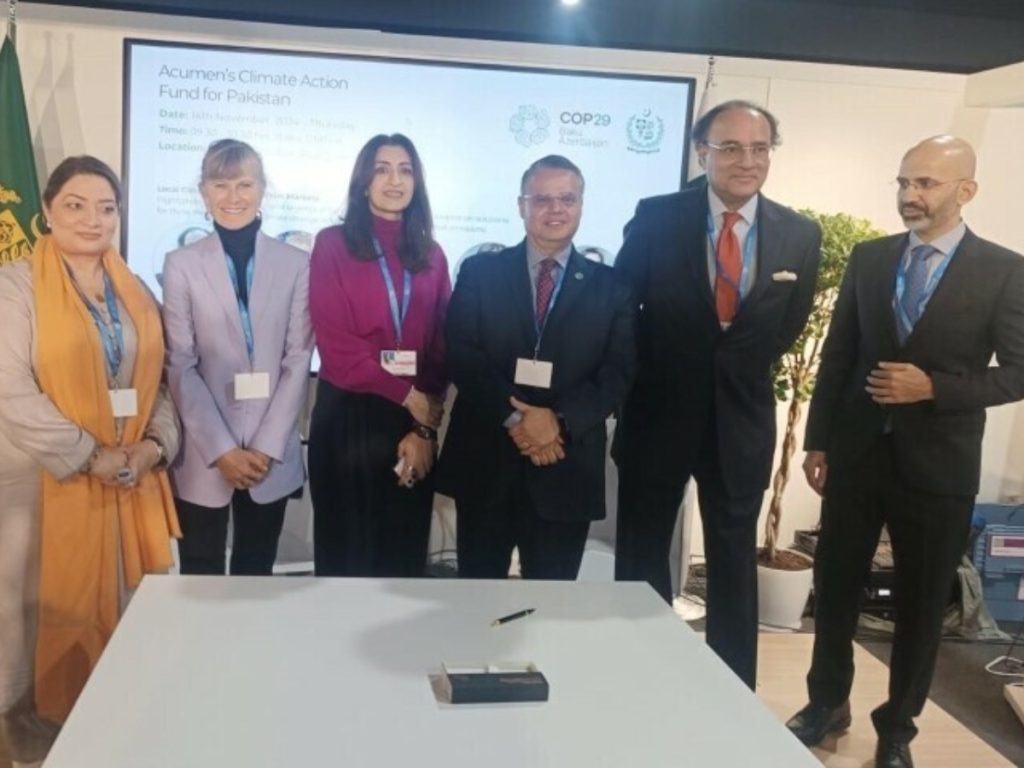
Baku ( November 15,2024) : During the COP29 climate conference in Baku, Pakistan introduced its National Climate Finance Strategy (NCFS), a framework designed to enhance access to global and domestic funding for addressing climate-related challenges.
The launch took place at the Pakistan Pavilion, led by Finance Minister Muhammad Aurangzeb and Prime Minister’s Coordinator on Climate Change Romina Khurshid Alam.
According to a statement from the Ministry of Climate Change and Environmental Coordination, Pakistan is among the most vulnerable countries to climate impacts, suffering a $30 billion loss in the 2022 floods that affected 33 million people and caused 1,700 deaths.
Aisha Humera Moriani, Secretary for the Ministry, emphasized the need for climate finance in her address, highlighting the strategy’s objectives of boosting resilience, defining institutional roles, and improving access to diverse funding sources.
Aurangzeb called the NCFS a systematic plan for securing climate finance, built on transparency, accountability, and inclusivity. He noted that the strategy prioritizes funding for initiatives that enhance resilience and support sustainable development.
Alam, in her keynote speech, stated that the NCFS aims to bridge Pakistan’s climate finance gap, estimated at $348 billion by 2030. The strategy aligns with a whole-economy approach, focusing on investments in vulnerable sectors and climate-proofing resources. A dedicated climate finance portal will track inflows and outflows, ensuring transparency.
The NCFS integrates goals such as resilient infrastructure, climate-smart agriculture, and ecosystem-based livelihoods for a sustainable future. Alam also emphasized inclusivity, particularly policies that empower marginalized communities, including women, while promoting sustainable practices.
The strategy builds on Pakistan’s National Climate Change Policy, which targets a 50% reduction in emissions by 2030, with 15% through domestic measures and 35% conditional on international support. Current projects like mangrove restoration and renewable energy initiatives reflect these commitments.
World Wildlife Fund-Pakistan President Adil Najam urged developed nations to fulfill financial commitments to support vulnerable countries. The Climate Vulnerable Forum’s Secretary General Mohamed Nasheed called for collective efforts to combat environmental challenges, while the World Bank’s Tom Kerr praised Pakistan’s NCFS as a milestone in exploring funding channels to address climate risks.