
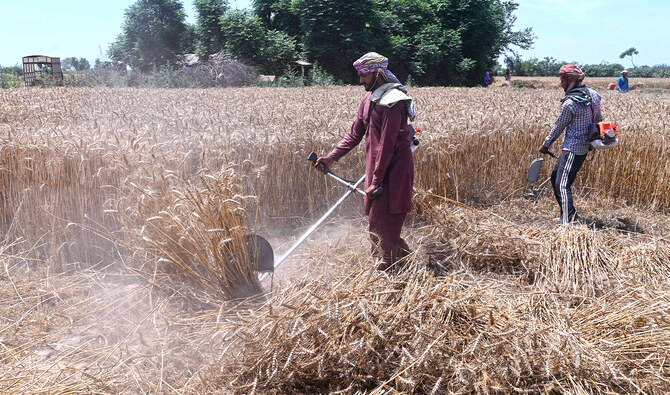
Pakistan’s agriculture sector achieved significant growth in the 2023-24 fiscal year, with wheat production reaching 31.4 million tons, surpassing the previous year’s 28.2 million tons.
During the 2023-24 fiscal year, Pakistan’s agriculture sector expanded by 6.25%, playing a vital role in bolstering the national economy.
Nearly all major crops recorded higher yields, with wheat production exceeding expectations. The wheat harvest reached 31.4 million tons, up from 28.2 million tons the previous year. As a staple crop, wheat contributes 9% to agriculture and accounts for 2.2% of Pakistan’s gross domestic product (GDP).
Similarly, rice production surged by an impressive 34.8%, rising to 9.9 million tons in FY24 compared to 7.3 million tons in the prior year. Cotton also experienced remarkable growth, with a 13.1% increase in cultivation leading to a staggering 108.2% rise in output, reaching 10.2 million bales.
In contrast, sugarcane production saw a slight decline of 0.4%, dropping to 87.6 million tons in FY24 from 88 million tons the previous year.
Despite this bumper crop, farmers are experiencing financial difficulties. The Punjab government’s decision, influenced by an agreement with the World Bank, to abstain from wheat procurement has left farmers dependent on open market prices, which often fall below the government’s minimum support price of Rs3,900 per 40 kg. This shortfall has led to substantial financial losses for growers.
In response, the Punjab government has introduced initiatives such as the Kissan Card program, offering interest-free loans and subsidies on agricultural inputs, and plans to solarize tube wells.
However, stakeholders argue that these measures need broader implementation to effectively support the farming community. Additionally, rising costs of inputs like seeds, electricity, and diesel, along with challenges in receiving timely payments from sugar mills, continue to strain farmers’ livelihoods.
“The open market was not paying the minimum support price and if we consider a price lower by at least Rs100 per 40 kg, which was offered to farmers, then one can easily guess how much money growers have lost,” remarked Pakistan Kissan Ittehad President Khalid Mahmood Khokhar.
He elaborated that wheat was like an engine for farmers; if they got the best price, then it had a positive effect on other crops too.
“In FY24, wheat farmers got the minimum support price of Rs3,900 per 40 kg, which resulted in a staggering growth of 6.25%. This year, I believe wheat crop will see a setback, triggering a negative growth in the overall agriculture sector,” Khokhar warned.