

As Pakistanis face ongoing socio-political, economic, and security issues, they are also confronted with climate-related challenges like air pollution, which endangers both their environment and their overall health.
According to an annual Air Quality Life Index (AQLI) report from the University of Chicago’s Energy Policy Institute (EPIC), the deteriorating air quality in the country is significantly impacting the life expectancy of its citizens.
According to the report, Pakistanis — as part of South Asia, the world’s most polluted region — are exposed to particulate pollution levels that are 22.3% higher than that experienced at the turn of the century.
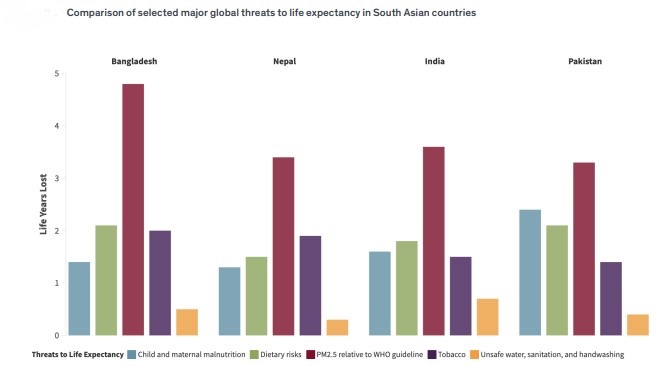
The report maintained that since virtually the entire population of Pakistan breathes air that doesn’t meet the PM2.5 standard set at 15 µg/m³, people’s life expectancy could be increased by 2.3 years if the country can meet its own PM2.5 standard.
“In Pakistan, where the PM2.5 concentration was 38.9 µg/m³ in 2022 — 10% lower compared to the particulate levels in 2021, the average resident would gain 3.3 years from meeting the World Health Organisation (WHO) guideline,” read the AQLI 2024 annual update.
“Those in Peshawar, the most polluted city in the country, would gain 5.6 years,” it added.
The AQLI report highlighted a dramatic rise in factors contributing to air pollution, noting that the number of vehicles in the country has roughly quadrupled since the early 2000s, along with a significant increase in fossil fuel use for electricity generation.
The report observed that 94 out of 252 countries and territories worldwide had national air quality standards, covering 80% of the global population. However, it also pointed out that 37 of these countries failed to meet these standards, which represents 30% of the world’s population.
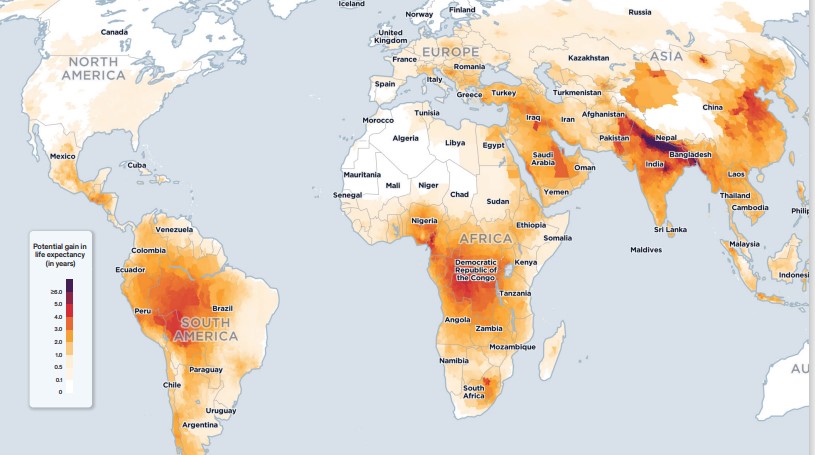
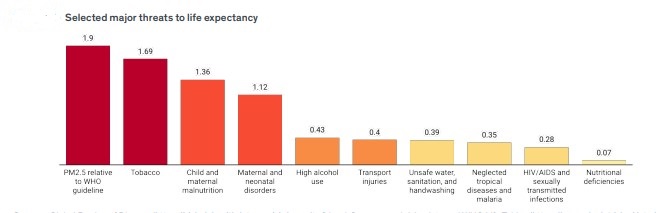
Describing global pollution as the “greatest external threat to human life expectancy,” the report indicated that individuals in the most polluted regions breathe air that is six times more contaminated than that in the least polluted areas. As a result, their life expectancy is reduced by an average of 2.7 years compared to those living in the cleanest environments.